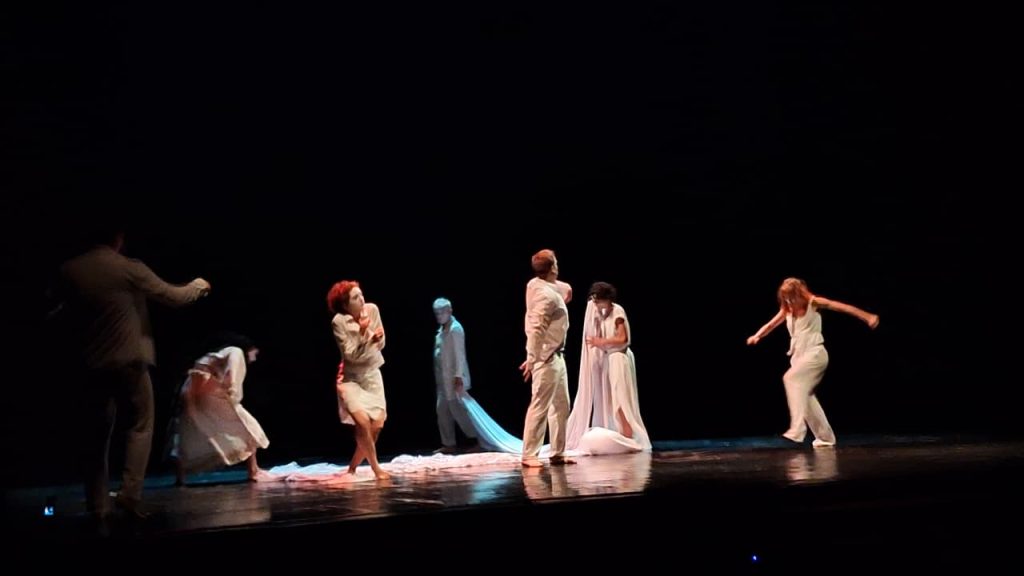
JAKARTA – On Sunday night, November 1, 2026, the German theater group Tangoing Performance presented their unique show, Now Here (NOWHERE). Director Peter Ohrt led the production at the Cak Durasim – East Java Cultural Center. The group performed without a script, a written dialogue, or a fixed storyline. Instead, they relied on the Amerta Movement philosophy—a discipline inspired by the late Solo dance master Prapto Suryodarmo—to explore physical expression, human relationships, and nature.
Rooted in Javanese Dance Philosophy
The performance explored free movement through the Amerta Movement philosophy. Through this method, the physical body becomes a direct tool to connect human experience with nature and the environment.
Director Peter Ohrt did not offer a single fixed story for the audience to follow. Instead, he allowed each movement to grow naturally during the show. Consequently, the performance created unexpected possibilities for everyone in the room.
Peter explained that his team wanted to find a universal language through the body. He strongly believes that human bodies carry deep stories without needing spoken words.
“We want to find a language for everyone, not a language for talking,” Peter shared after the performance. “The body has a story, not the meaning of words.”
Peter led an acting school in Hamburg for 26 years, and he has studied body movement techniques for decades. For this specific project, his group completed an intensive two-week residency in Surabaya. They trained together in local halls and traditional wooden pavilions (pendapa).
City Energy and Stage Freedom
Furthermore, the atmosphere of Surabaya deeply influenced their artistic process. Peter loved the vibrant energy of the city and its warm residents. He deliberately avoided looking at Surabaya merely as a tourist. Instead, daily city life directly shaped the performance on stage.
“When we perform, the audience creates their own story from our actions,” Peter explained. He emphasized that the group did not tell a forced story because they relied purely on real-time improvisation.
According to Peter, live improvisation always carries risk. The actors must step into unknown paths together without knowing the final outcome. Thus, their physical interactions change constantly throughout the show. This freedom gives the audience complete space to find their own meaning based on personal life experiences.
Reading the Symbols: From Nature to Politics
Local art observer Henri Nurcahyo noted that Now Here (NOWHERE) reflects the core values of the Amerta Movement. In this style of performance, both movement and music spring from immediate reactions. The actors continuously respond to themselves, each other, stage lights, and simple objects. As a result, every audience member develops a unique interpretation.
Henri suggested that viewers pay special attention to the opening scene. The combination of heavy rain, trees, and moving black fabrics creates a strong entry point for understanding the rest of the show. Behind the rain and darkness lies a mystery that humans cannot fully control.
Additionally, Henri highlighted a simple wooden chair as a central prop. Throughout the show, the actors lifted, flipped, rolled, and fought over this single object.
In a social and political context, the chair easily symbolizes power, rank, and status.
“The chair clearly represents position and power,” Henri noted. He added that focusing on the chair helps people expand their imagination about the play’s deeper meaning.
This idea matches real life, where people constantly fight to gain and keep political power. However, the performance does not force this view on anyone. The freedom to read these visual symbols forms an essential part of the artistic experience.
Warm Welcome in Surabaya
The audience showed great excitement throughout the evening. A large crowd packed the hall, and many people sat on the floor because seats ran out completely.
Lila Oktavia Sona Wijaya, a theater student from UINSA Surabaya, enjoyed the unique experience immensely. She felt the performance exceeded her expectations.
“This is my first time watching an international theater group,” She said. She learned a lot about physical expression from the German actors, and she also connected the fight over the chair to political struggles in Indonesia.
Meanwhile, Mike Neuber from Wisma Jerman stated that the show offered a rare cultural experience for Surabaya. He praised the actors for creating spontaneous movements without a written script. Furthermore, Mike highlighted the high enthusiasm of the local audience. He hopes this performance marks the beginning of long-term cooperation between Indonesian and German artists, paving the way for future cross-cultural arts exchanges.
Photo doc. seni.co.id