JAKARTA – In Indonesia, communities originally crafted hoes, bamboo carrying poles, slit drums, and rice-field bird scarers to meet daily practical needs. However, when instrument makers explore the sonic possibilities within these everyday objects, the tools discover a new life in musical experimentation. The Dewan Kesenian Jakarta/ DKJ (Jakarta Arts Council) – Music Committee initiated this vision, and the International Ethnic Music Festival (IEMF) 2026 brought it to life through the #TAMANSUARA sound installation at Taman Ismail Marzuki, Jakarta, from November 6 to 10. Specifically, the festival united local and international artists, instrument makers, and communities to reveal the vital link between sound, local knowledge, and daily life. Furthermore, the Jakarta Arts Center Management Unit oversaw IEMF 2026. Meanwhile, the DKJ Music Committee acted as curator and supervisor, while Yayasan Artbound Indonesia and the Indonesia World Music Series served as organizing partners.
Discovering Sound
Among the participating creators, instrument maker Hewod from Rengel, Tuban, East Java, immediately captured visitors’ attention. Specifically, he explored several instruments, including the ongkek, a traditional carrying pole of bamboo and lontar palm leaves that traveling vendors once used to carry legen and tuak. In Hewod’s hands, the ongkek no longer functions merely as a transport tool. As Hewod explained, “We developed the ongkek into an instrument that musicians can play through various techniques, ranging from percussion and plucking to bowing and blowing, because its construction and materials open up diverse spaces for exploration.”
Similarly, from Pacitan, Paguyuban Song Meri Chairperson Aminudin presented several instruments, including the Klentowongan. Farmers previously installed this hollow bamboo device in rice fields. Consequently, whenever the wind blows across its openings, the bamboo emits a piercing shriek that drives away crop-damaging animals. In addition, Lawe Samagaha from Bogor explored several bamboo devices, notably the Burung-burungan and the Kohkol. While the Burung-burungan generates sound through a spinning mechanism, communities once used the Kohkol to mark time, summon residents, issue warnings, and support neighborhood night watches. Moreover, Lawe showcased the Klotok, a bamboo tube that resonates when the wind moves its wooden clapper, alongside the Tribuana, which blends the karinding, kleuweuk, and bird-voiced bamboo. He also built the Walangan, a wing-like bamboo structure with hanging klotok and kleuweuk pieces for stage performances.
Meanwhile, artist Wukir Suryadi from Malang, who now resides in Salatiga, unveiled Titir VX, an artistic reinvention of the traditional kentongan slit drum that integrates springs, wires, metal plates, and digital effects. Whereas communities originally used the kentongan for communication and danger alerts, Wukir transformed it through Titir VX into a sonic instrument that broadcasts warnings about global crises and environmental destruction. Ultimately, these diverse works prove that sonic exploration goes far beyond searching for novel sounds. Instead, instrument makers reopen stories about how communities crafted, used, and wove everyday objects into social life.
For instance, Misbahuddin—an artist from Selayar Island, South Sulawesi, who now lives in Pacitan, East Java—actively rallied regional artists for this exploration. As he explained, “They do not simply create musical instruments here; rather, they respond to everyday traditional tools that maintain a direct connection to community activities.” Specifically, he cited the Lodong from Cibaliung, Banten, a bamboo container that farmers use to collect palm sap. Meanwhile, Rimanto and Mulyono from Wonogiri developed the Tali Angin (Wind String) and Kincir Angin Bambu (Bamboo Windmill), both of which harness wind power to generate motion and sound that repel agricultural pests. According to Misbahuddin, the network of instrument makers in this installation spans five regions: Tuban, Pacitan, Wonogiri, Cibaliung in Banten, and Bogor. Furthermore, the festival united distinct practices from each local environment so the public could experience and play the instruments firsthand.
Knowledge Behind the Sound
For Misbahuddin, instrument exploration also operates as a process of sharing knowledge. Accordingly, each sound device carries a narrative encompassing its history, social function, raw materials, crafting methods, assembly techniques, and playing styles. “The aesthetic practice that we build here runs hand in hand with knowledge practice,” he noted. In fact, instrument makers rarely know from the outset the exact shape and sonic character their creations will produce. Therefore, they experiment relentlessly with materials, structures, and playing techniques until they uncover each object’s musical potential. Musicians can subsequently shape the emerging sounds through live performance, tempo variations, amplification, and specific audio effects.
Similarly, DKJ Music Committee member Amar Aprizel echoed this perspective. He emphasized that listeners cannot understand traditional music solely through its musical forms or instruments, and instead they must examine it alongside the community life that birthed it. “Traditional music forms a system of knowledge and a system of community life,” Amar stated. Moreover, he reminded audiences that people often narrow tradition down to a static art form that society must preserve unchanged. “In reality, traditional sound devices emerged from communities’ practical needs to work, communicate, cultivate nature, perform rituals, and build collective life,” he added.
Learning from Instruments
The festival actively implemented this knowledge-sharing mission through workshops for junior and senior high school students. Specifically, within the sound installation’s public space activation program, IEMF 2026 partnered with NITRA and Yayasan Artbound Indonesia to apply a learning method that blends play with music education. According to Misbahuddin, the Artbound method extends far beyond the mere mechanics of playing an instrument. Instructors also guide students to investigate each object’s background, the acoustic reasons behind its sound, its creation history, and its role in community life. For example, facilitators introduced the dangong, which communities also call the Daren. Consequently, students learned not only how to play the instrument, but also how artisans craft and assemble it. Through this hands-on experience, young participants grasped culture directly rather than relying solely on theoretical explanations. Furthermore, Amar viewed these workshops as a vital transfer of knowledge to the next generation, ensuring that youth understand the human lives behind every instrument.
Tradition in Motion
This overarching vision of sound and life shaped the festival’s grand framework under the theme “Sound Tradition: Rites, Body, and Memory“. In their curatorial statement, the organizers emphasized that traditional music across the Indonesian archipelago never stands in isolation. Instead, sound weaves deeply into rituals, childbirth, children’s lullabies, death, daily labor, and the very soil that farmers cultivate.
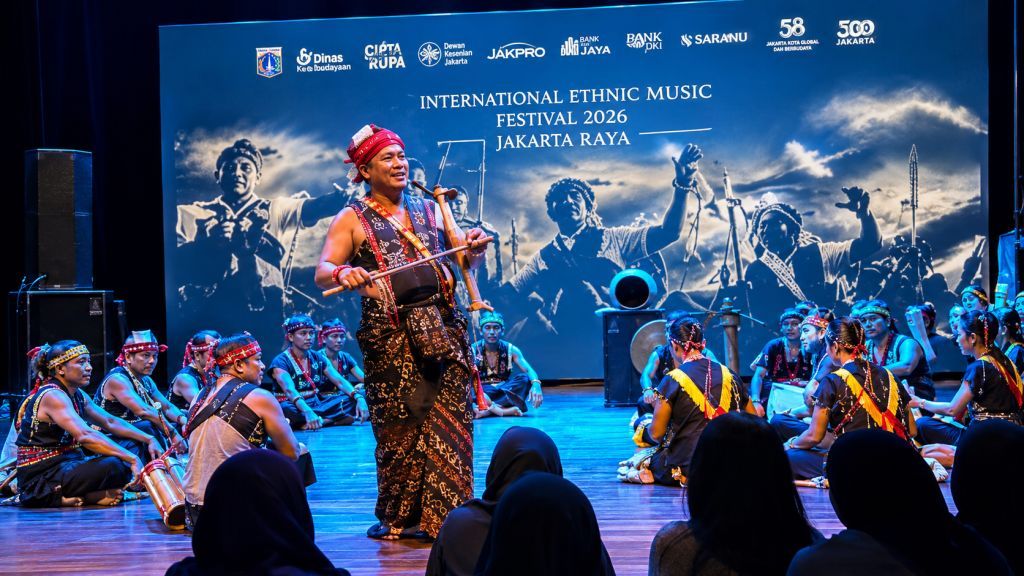
Beyond the sound installation, the festival staged live performances that mapped the human life cycle through sonic traditions. Specifically, Batimang and Badondo from Kampar, Riau, represented the art of lulling children to sleep, while the School of Living Tradition from Lake Sebu, the Philippines, presented traditions surrounding childbirth. Meanwhile, Topeng Jantuk from Margasari, Bekasi, celebrated life while opening and safeguarding the theatrical journey. In turn, Pa’marakka from Tana Toraja and Reba from Bajawa, Flores, showcased traditions surrounding funerary rituals. Additionally, Thethek Melek from Pacitan, which springs from agrarian life, and Janturan Banyumasan, which weaves community sounds with oral storytelling, completed this performance cycle.
Furthermore, the public discussion program “Kesurupan dan Bunyi” (Trance and Sound) explored the intersection of acoustics, the human body, and trance phenomena through the lenses of sound frequency and social psychology. Notably, speakers anchored this dialogue in the use of local archipelago sounds within the film Para Perasuk and the traditional Ebeg art practice. The festival also sparked cross-cultural dialogue through a collaboration with Touquetori, a South Korean musical duo that blends traditional Korean elements with modern electronic beats. Through their masterclass “From Traditional Music to Global Music,” the duo teamed up with Jakarta musicians and ethnomusicology students from the Institut Kesenian Jakarta / IKJ (Jakarta Institute of Arts) to explore contemporary evolutions of traditional music. As Amar remarked, “The diverse programs at IEMF 2026 demonstrate that communities do not merely display tradition as static heritage. Rather, tradition serves as a wellspring of knowledge, a catalyst for artistic exploration, an educational space, and even a medium for cultural diplomacy.”
Nurturing Knowledge
Ultimately, the International Ethnic Music Festival 2026 demonstrated that traditional music encompasses far more than stage performances, compositions, or sonic beauty. Beneath every note lies a rich ecosystem of knowledge that unites instrument makers, local communities, natural materials, artisanal skills, and human experience. Indeed, Hewod, Aminudin, Lawe Samagaha, Rimanto, Mulyono, and Wukir Suryadi proved that musical creation can spring from knowledge systems outside formal music education. Therefore, their practices represent not merely artistic experiments, but vital ways of understanding how music intertwines with daily life.
Nonetheless, cultural advocates face the ongoing challenge of ensuring that these practices do not stop at mere festival attractions. Consequently, society must integrate thorough documentation, continuous education, experimental spaces, and tangible support for instrument makers into its broader cultural preservation efforts. After all, whenever a musician sounds a carrying pole, slit drum, or bird scarer once again, listeners hear far more than the mere resonance of an object. Instead, traces of human labor, natural environments, craftsmanship, and collective memory echo within every tone. Ultimately, nurturing sound traditions means safeguarding the very human knowledge that makes those sounds possible.
Photo doc. seni.co.id