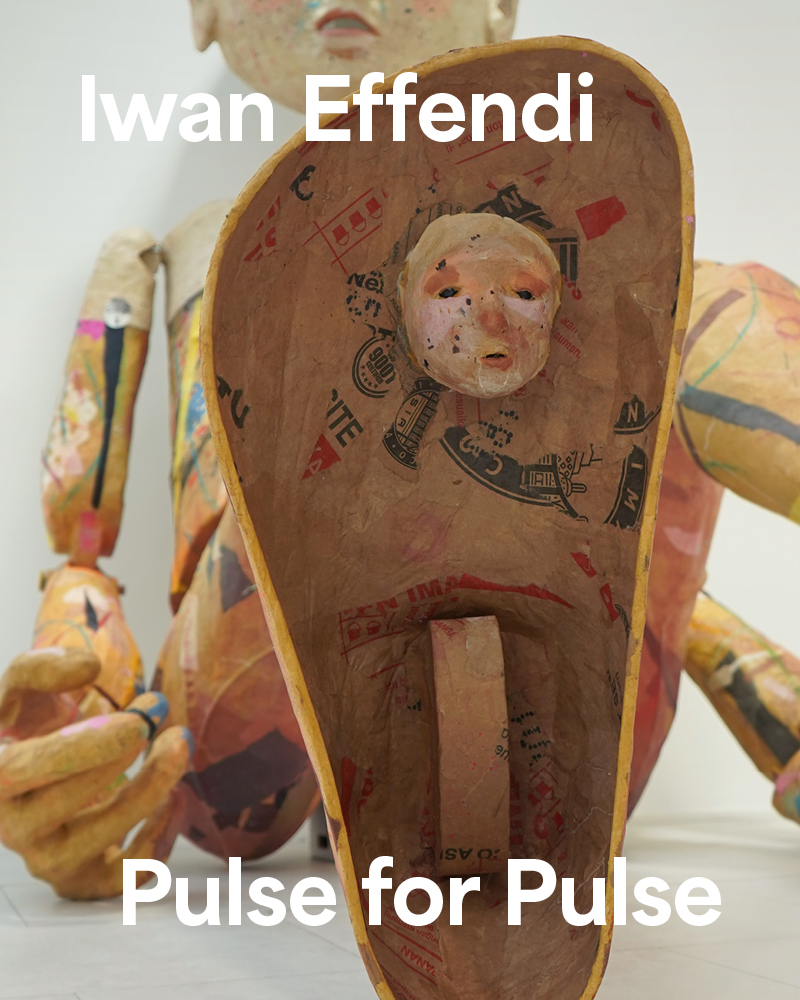
JAKARTA – Yogyakarta-based artist Iwan Effendi brings the magic of Papermoon Puppet Theatre into a new setting through his solo presentation, Pulse for Pulse (Denyut demi Denyut). Museum MACAN in Kebon Jeruk, West Jakarta, opened this special exhibition on November 14, 2026, and will run the showcase until April 2027. As one of five new exhibitions at the museum, the show invites visitors to experience puppets outside a traditional theater stage.
Upon entering the front area of Museum MACAN, visitors immediately encounter a row of Iwan’s signature puppets alongside a site-specific mural that towers over five meters high. These figures feature dreamy faces, oversized heads, and smaller proportions, representing the unique human characters of the artist, whom friends affectionately call Papeyo. Furthermore, Effendi drew inspiration for the mural from traditional wayang screens. “The mural takes inspiration from a wayang screen, where the puppets on the right and left sides act as simpingan,” Iwan explained during a preview on Thursday, November 12, 2026. “They serve as decorations, yet sometimes these characters perform or enter the play. In my view, these figures look just like we are about to perform as a puppeteer.”
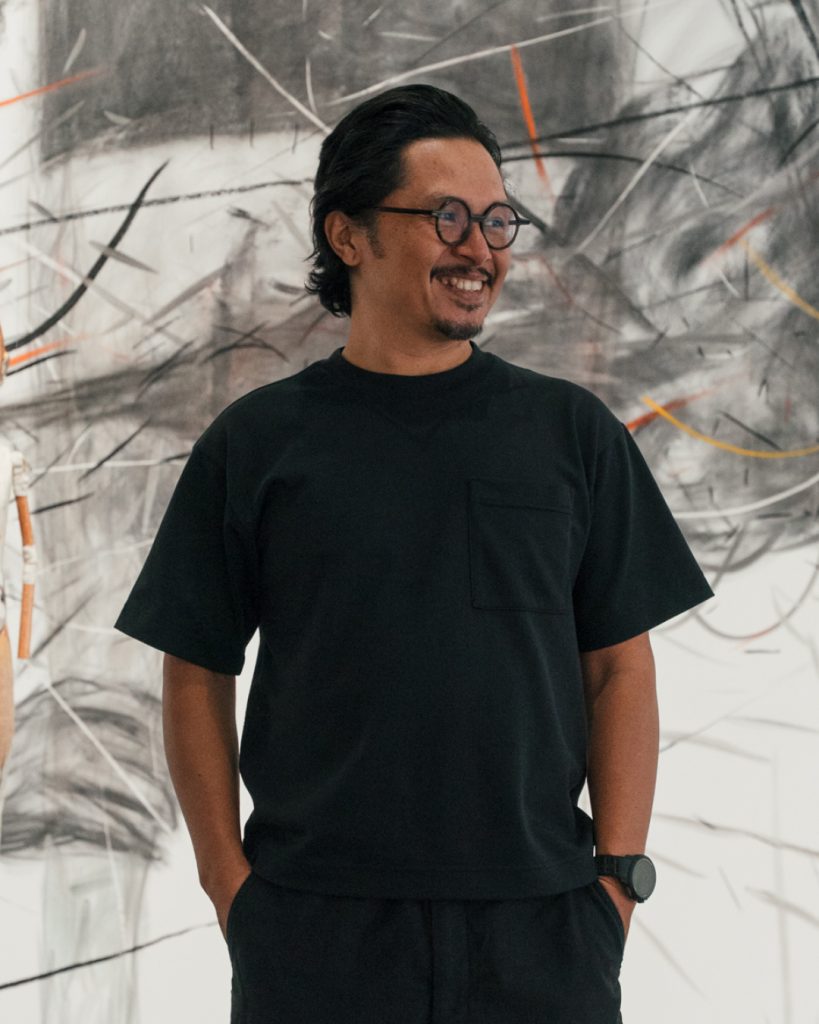
In addition to traditional Javanese influences, Iwan incorporates Japanese craftsmanship into his works. He crafted all the puppets using papier-mâché, a technique he and the Papermoon Puppet Theatre team mastered during an artist residency in Japan. Notably, one section displays a puppet seated in a wheelchair. “That is kuruma ningyo, where kuruma means wheeled chair and ningyo means puppet,” He shared. “We adapted this Japanese technique from the Edo period for Papermoon Puppet Theatre.”
Beyond static displays, the exhibition encourages direct audience engagement. For example, an artwork titled The Mediator invites visitors to sit down and gaze directly at a wooden puppet in front of them. “You sit and observe the puppet, which mirrors the creative process in puppet theater,” Iwan said. “You figure out and imagine the figure until it feels alive enough for someone to play with or sit across from. So, go ahead and interact with it.” Similarly, Effendi showcases his labor-intensive stop-motion animation. He drew the piece using charcoal at a rate of 10 frames per second, meaning the 6.5-minute video required him to draw, record, and erase 9,000 individual frames.
Another highlight of the exhibition is Lembam, a giant three-meter reclining sculpture made of traditional Japanese washi paper. Visitors previously saw this striking artwork at Art Jakarta Papers, and it now returns to greet the public in Jakarta. Specifically, Effendi created Lembam last year during the devastating flash floods in Aceh Tamiang. “I created Lembam last year when the Aceh Tamiang floods dominated the news,” Effendi recalled. “I could not describe the event in words. In photos of the sculpture, water submerges the chest area while the top remains white. I did not want to make it look overly tragic or dramatic, yet the lower body appears torn apart.”
Consequently, these accidental moments shaped the core philosophy behind Lembam. Effendi translates the word lembam as “reluctant to move,” and he uses this concept as his formula for designing puppets. “We do not create a puppet that looks fully alive, nor do we make one that looks completely dead,” Iwan noted. “Instead, the puppet must look lazy so that we, as puppeteers, must help it move.” Through this approach, He explores what he calls a “triangle of trust,” where a puppet comes to life through the choreographed movement of the puppeteer, the physical object, and the audience’s attention.
Ultimately, Pulse for Pulse reflects Iwan’s rich journey in contemporary art. Since co-founding Papermoon Puppet Theatre in Yogyakarta in 2006 with Maria Tri Sulistyani, he has worked at the crossroads of puppetry, drawing, painting, and performance. His practice continuously explores kinetic movement, memory, and human connection. Today, Iwan Effendi’s career spans solo exhibitions at Mizuma Art Gallery in Tokyo, The Back Room in Kuala Lumpur, and ara contemporary in Jakarta, alongside prestigious residencies in Japan, Australia, and New York.
Photo doc. Museum MACAN